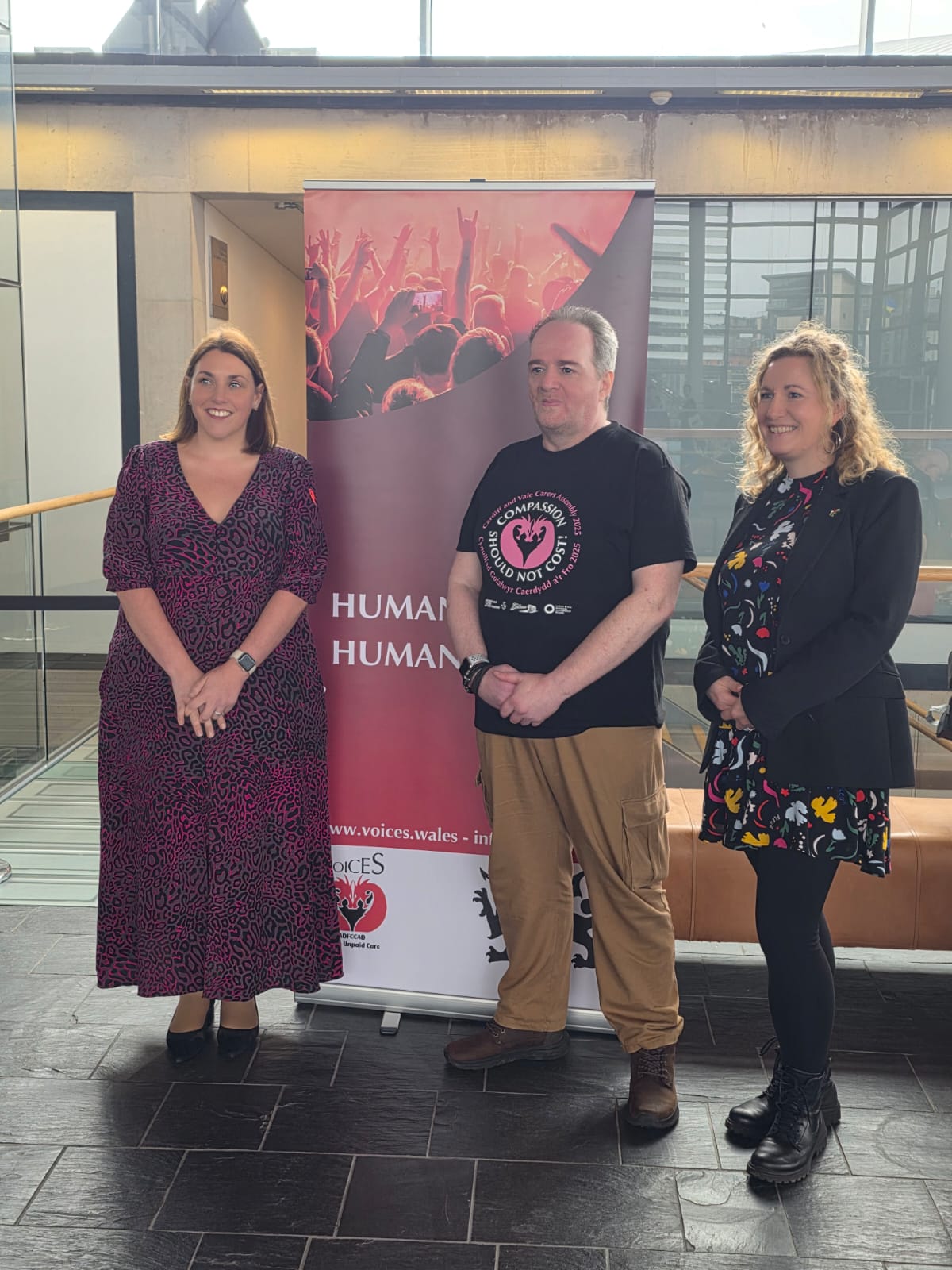

I recently had the privilege of attending a Senedd event organised by VOICES ADFOCAD. It was a powerful reminder of why care, and those who provide it, must be at the heart of the next Welsh Government’s priorities, not treated as an afterthought.
This is a cause close to my heart: growing up I spent much of my childhood in the care home where my nan worked. I got to know residents like Bill who would tell stories of World War II, and Frieda who slipped me Swiss chocolate, telling me about her childhood in Austria. Those experiences shaped my understanding of dignity, connection, and what it means to age with dignity. And this continued into my young adult life. As a university student I couldn’t afford to live in halls and instead lived with my mum in sheltered accommodation for older people, where she was live-in manager. Care wasn’t abstract to me; it was daily life and real people.
The reality of unpaid caring hit home when my nan died after a heart attack, following years of caring for my granddad, who had mobility issues and dementia. Caring was never a burden to her. What failed her was the lack of support around her. Like so many carers, she carried on quietly, until her body could no longer keep going. Before that, I didn’t really know what an “unpaid carer” was. And I know now that many families don’t realise it either, until they’re already in crisis.
Because of these experiences, I understand the reality facing older people with care needs, and the crucial role carers – especially unpaid carers – play. They are the invisible web that holds society together.
Unpaid carers save the Welsh NHS billions, often at the expense of their own financial, mental, and physical wellbeing. It’s not an exaggeration to say without them, the health sector in Wales would collapse. We already face severe shortages in social care staff in Wales, and a health service under immense strain. Health infrastructure is more than just the bricks and mortar and physical disrepair as a result of Labour’s mismanagement of the Welsh NHS and fourteen years of Tory austerity. Without unpaid carers stepping in for children, partners, parents, and loved ones, hospitals would grind to a halt. Patients could not be discharged. We’re all too familiar with the images and stories of ambulances backing up outside A&E, and the horror stories of patients being treated in corridors. Doctors, nurses and support staff, already stretched to breaking point, would face an impossible situation.
Care is infrastructure. It underpins everything else. Yet it is routinely undervalued, underpaid, or not paid at all. While carers struggle, profits are funnelled elsewhere. This is not an accident. It is a political choice.
Most of us will need care at some point in our lives, or we will become carers ourselves. Yet unpaid carers often have no clear rights, no collective voice, and little recognition for the essential role they play.
That is why the work of VOICES ADFOCAD is so important.
When I first met the co-founders, Mike (who is a Plaid Cymru member and activist in the Vale of Glamorgan, and who I hope I will represent after the Senedd election) and Bobby Jo, they were campaigning for recognition for unpaid carers across Wales. Their worry was for the people they care for, not themselves. Their fear was simple and profound: if something happened to them, the people they support would be left vulnerable and alone. Carers across Wales face that reality every day.
This support and care offered by young and unpaid carers often comes at great personal cost. And while Welsh legislation gives carers strong rights on paper, carers are often not aware of the legal guarantees or are stuck in backlogs of assessment.
VOICES ADFOCAD and I want to close that gap, and for Welsh Government and local authorities to move from rhetoric to action.
Their manifesto is clear: carers need sustained, multi-year funding, better access to information and support, and real equity when it comes to breaks and respite. Extending the Short Breaks Scheme across Wales and investing in high-quality, community-based respite services must be priorities. These are not radical demands. They are practical, achievable steps that would make a real difference to people’s lives. They must be part of Wales’s legislative programme in the next Senedd term.
No more sticking plasters. No more relying on goodwill while ignoring the cost to carers themselves. We must properly recognise unpaid carers and give them the rights, support, and respect they deserve.
We won’t fix decades of neglect overnight. But we can choose a different direction. We can start now. And we can do far more than has been done before to build a care system rooted in dignity, fairness, and shared responsibility.